

Books / Guide / 15 Ways To Overcome Writer’s Block
Free with newsletter | Writing guide · 2018 (Revised 2026)
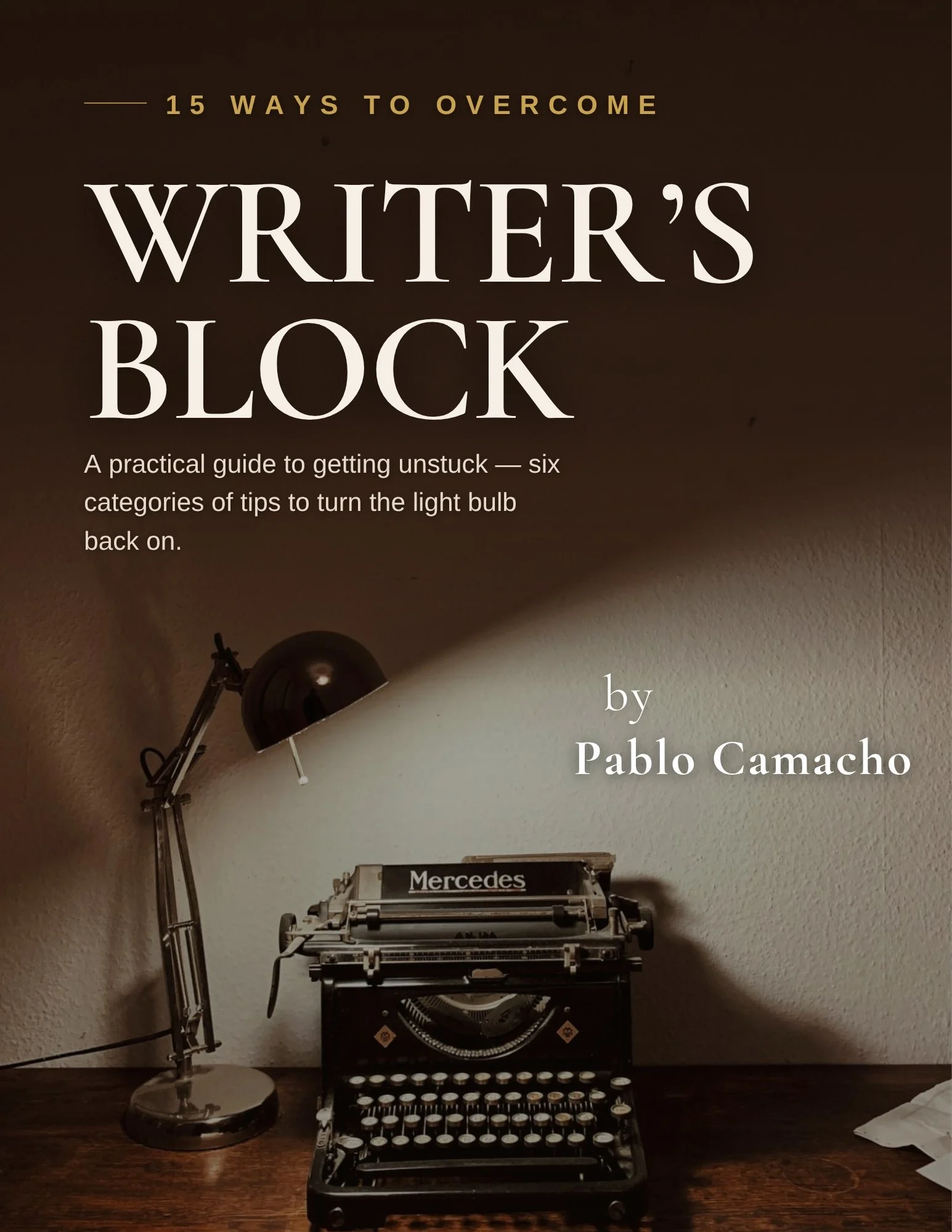
15 Ways to Overcome Writer’s Block
A practical guide to getting unstuck
This guide includes six categories of tips for days when the page won’t move—the same ones I used in the military to finish a book in the field, at night, with a flashlight and a word count to hit.
WHAT'S INSIDE
Fifteen tips, six categories
Most writers get stuck because they lean on a single source of inspiration. When it dries up, there's nowhere to go. These fifteen are organized into six different places to look — so when one fails, you have five more.
ONE · THE TECHNICAL
Get something on the page
Brainstorming and mind-mapping · Force yourself to write
TWO · THE PHYSICAL & MENTAL
Get out of your own head
Run · Meditate · Be an animal
THREE · THE SOCIAL
Borrow someone else's eyes
Get a different perspective · Talk to people · Examine your relationships
FOUR · THE ENTERTAINMENT
Refill the tank
Read more books · Movies, plays & television · Listen to new music
FIVE · THE CULTURAL
Step outside what you know
Try new foods · Learn a new language
SIX · THE LIVING OF LIFE
Go get something to write about
Travel the world · Try another passion
Tip #5 of 15 — free, right here
Be an animal
I know. This is an odd one. Hear me out.
Purposely thinking outside the human dimension can open doors to immensely different ways of thinking. What's your favorite animal? Which one do you wish you could be? Are you a bird — can you imagine yourself soaring over mountains and seas? Are you a snake that slithers, your thoughts flowing easily like water? A dragon of the sea, swimming as deep and far as you want? A wolf: the lone spirit, or do you believe in the strength of the pack?
The exercise:
Grab a blank piece of paper and draw two columns.
Pick an animal — one you love, or one that scares you.
Label one column “Me” and the other with the animal's name.
Think of a situation: falling out of a tree, being lost somewhere new, hearing a beautiful song for the first time.
List how you'd react as a human. Then list how the animal would react to the same thing.
Think about setting, time of day, the emotions of a living creature. Everything counts.
Be weird. Think outside the box. Clearly the old stuff wasn't working.
Will we race to the end,
like wind dancing through the valley,
and jump together into the water?
Would you trust that I can carry you,
that depths and cold are things I no longer fear…
From “Before the horizon,” in Bittersweet — written using this exact exercise.
That's tip 5. The other fourteen are in the guide.
36 pages · exercises, examples, and prompts for each one

WHO IT'S FOR
If any of this sounds familiar
You keep meaning to start
The idea has been in your head for months. The document is still empty, or it's three paragraphs you hate.
You stopped somewhere in the middle
You were going well, then something broke the rhythm and you haven't gone back. The longer you leave it, the harder it gets.
You write, but it feels flat
The words come. They just don't sound like anything. You're producing and not saying much.

WHY I WROTE IT
I stopped writing for six months—restarting was immensely difficult.
Early in my military enlistment, I stopped writing for about six months. When I decided to get back into it, it became one of the most mentally painful and seemingly impossible tasks I've ever faced — I knew the work wasn't the same quality as before.
So I forced myself to write one paragraph or poem a day. One turned into two. Two turned into pages. Before I realized it, I'd finished my first book, Love's Cycle.
Friends kept asking what I do to get unstuck. They asked so many times that I finally wrote it down. Nine books later, I still use these fifteen.
WHAT ELSE YOU GET
Three things, not one
The guide comes with the rest of the welcome bundle — all free, all yours to keep.

Red Magic
A full poetry collection — love letters written to someone who hadn't arrived yet.
The guide
15 Ways to Overcome Writer's Block, as a PDF and an EPUB.
10%
A discount code
10% off anything in the shop, including poetry prints. It doesn't expire.
WHEN YOU'RE UNSTUCK
The guide gets you writing. The course teaches you to write poems.
Fifteen tips will move you past a blank page. Becoming a Poet is the longer answer: six chapters on finding your voice, building imagery, and finishing a collection you'd actually share.
Your welcome email includes a code for 15% off.

GET UNSTUCK TONIGHT
Send me the guide.
Fifteen tips, two free books, and a discount code — in your inbox in about a minute.